29 Aug 2025
TM Q2 NET PROFIT RISES 1.7%, DECLARES 12.5 SEN INTERIM DIVIDEND
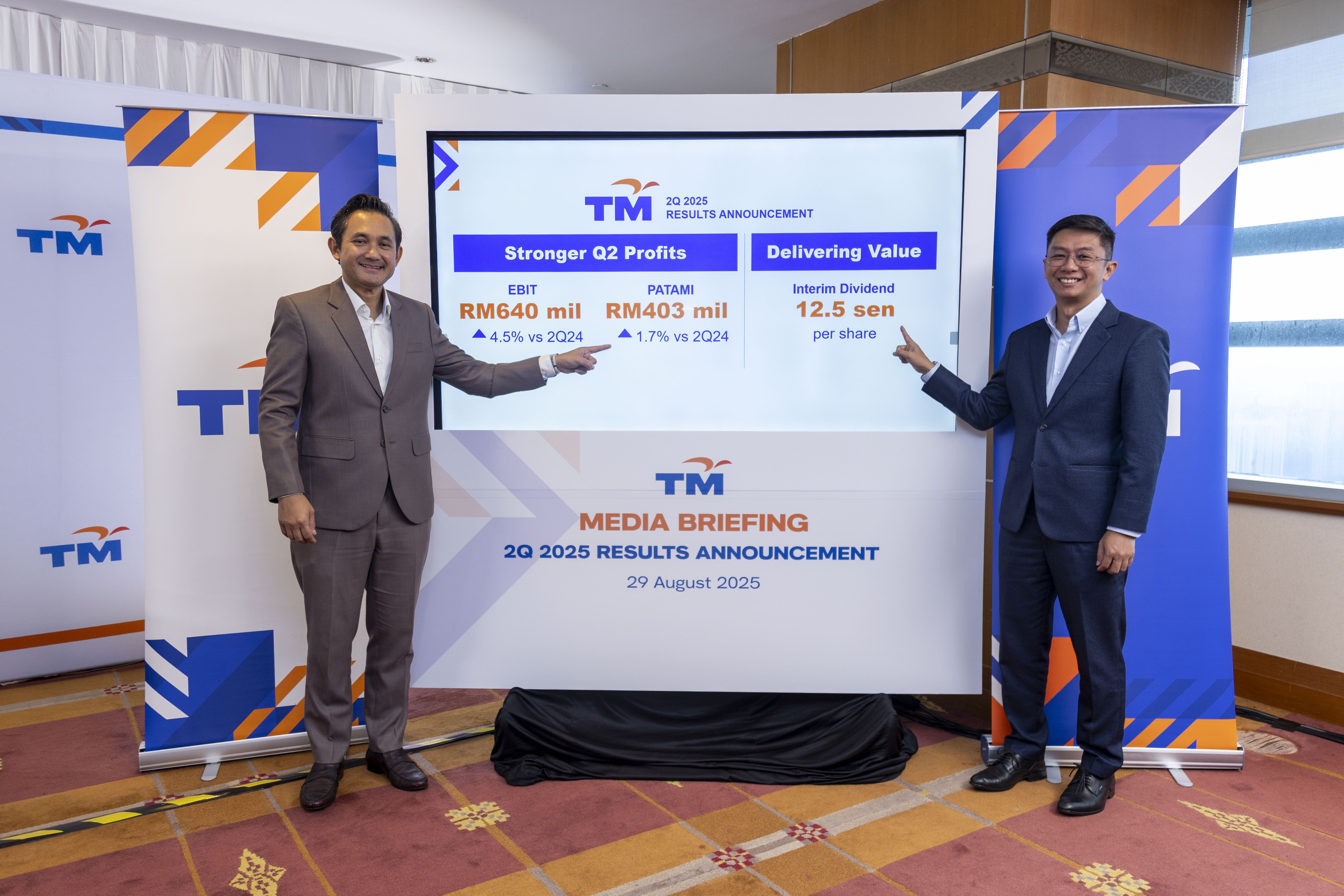

KUALA LUMPUR, 29 August 2025 – Telekom Malaysia Berhad (“TM” or “The Group”) today announced its financial results for the second quarter ended 30 June 2025 (2Q 2025), reflecting resilience in a competitive market and continued progress on its strategic priorities.
During the quarter, Profit After Tax and Non-Controlling Interests (PATAMI) rose 1.7% compared to corresponding quarter last year to RM403.0 million, while Earnings before Interest and Tax (EBIT) grew 4.5% to RM640.0 million.
For the first half of 2025 (1H 2025), revenue stood at RM5.62 billion versus RM5.74 billion a year earlier, as a result of intensely competitive market. Meanwhile, the Group registered EBIT of RM1.19 billion, down 5.8% compared to corresponding period last year, mainly due to forex losses. Adjusting for these, underlying EBIT recorded growth, underscoring TM’s strong fundamentals, core operations and cost discipline in delivering profit despite revenue pressures.
The Group continues to demonstrate its focus towards value creation and disciplined capital management, as reflected in the improvement of Return on Invested Capital (ROIC) to 12.81% from 12.34% a year ago. TM maintains a positive outlook for the year and is confident in meeting its 2025 guidance.
The Board has declared an interim dividend of 12.5 sen per share, amounting to RM479.7 million for the financial year 2025, reaffirming its commitment to delivering sustainable returns to shareholders.
1H 2025 Segment Highlights
- Business to Consumer (B2C): Unifi registered steady revenue performance and an increase in fixed broadband subscribers driven by Unifi UniVerse convergence offerings, fuelled by content and mobile take up. Its diverse range of device bundles continued to attract strong demands from various segments. Meanwhile, as the preferred partner to more than 400,000 MSMEs nationwide, Unifi Business segment remained a key driver, with tailored digital solutions that promote digital inclusivity.
- Business to Business (B2B): TM One revenue was softer as several major projects and sizeable deals are expected to be completed in the second half of the year. Nevertheless, beyond connectivity services such as cloud and ICT recorded steady growth.
- Carrier to Carrier (C2C): TM Global remains well-positioned, with a strong pipeline of large-scale border-to-border bandwidth requirements expected to be delivered by year-end. On the domestic front, the segment is on track with its data centre expansions and the delivery of 5G mobile backhaul in support of the national 5G agenda.
Investing for Future Growth
TM continues to strengthen its long-term position through strategic investments in digital technologies, encompassing AI infrastructure and applications, data centres, edge facilities, expanded fibre coverage, 5G mobile backhaul and submarine cable systems.
“Digital infrastructure and AI are no longer just a vision for TM. It’s becoming a reality, from the establishment of data centres, sovereign cloud and GPU-as-a-Service to various enterprise applications that continuously help businesses to unlock digital capabilities and growth,” said Amar Huzaimi Md Deris, Group Chief Executive Officer, TM.
“Equally important is ensuring digital inclusivity for all communities and businesses, while nurturing the right talent to power Malaysia’s digital future. Through our inaugural Jangkau Digital programme, we are reimagining Kampung Mukut in Pulau Tioman as the nation’s first Smart Eco-Village. At the same time, the launch of Malaysia’s first Faculty of Artificial Intelligence and Engineering at our education arm, Multimedia University, is a clear testament to this commitment. Together, these initiatives reflect TM’s greater purpose of empowering lives and ensuring no one is left behind in the digital era.”
Outlook
“While the market environment remains challenging, our results demonstrated resilience and ability to execute our strategic priorities. We are building positive momentum through stronger convergence growth, improved cost structures and disciplined capital management. With our investments in future-ready infrastructure, we are advancing towards our aspiration to become a Digital Powerhouse by 2030, while delivering sustainable value for our stakeholders,” Amar concluded.
YOU MAY ALSO LIKE
TM SHOWCASES AI AND DIGITAL LEADERSHIP AT ASEAN AI SUMMIT 2025
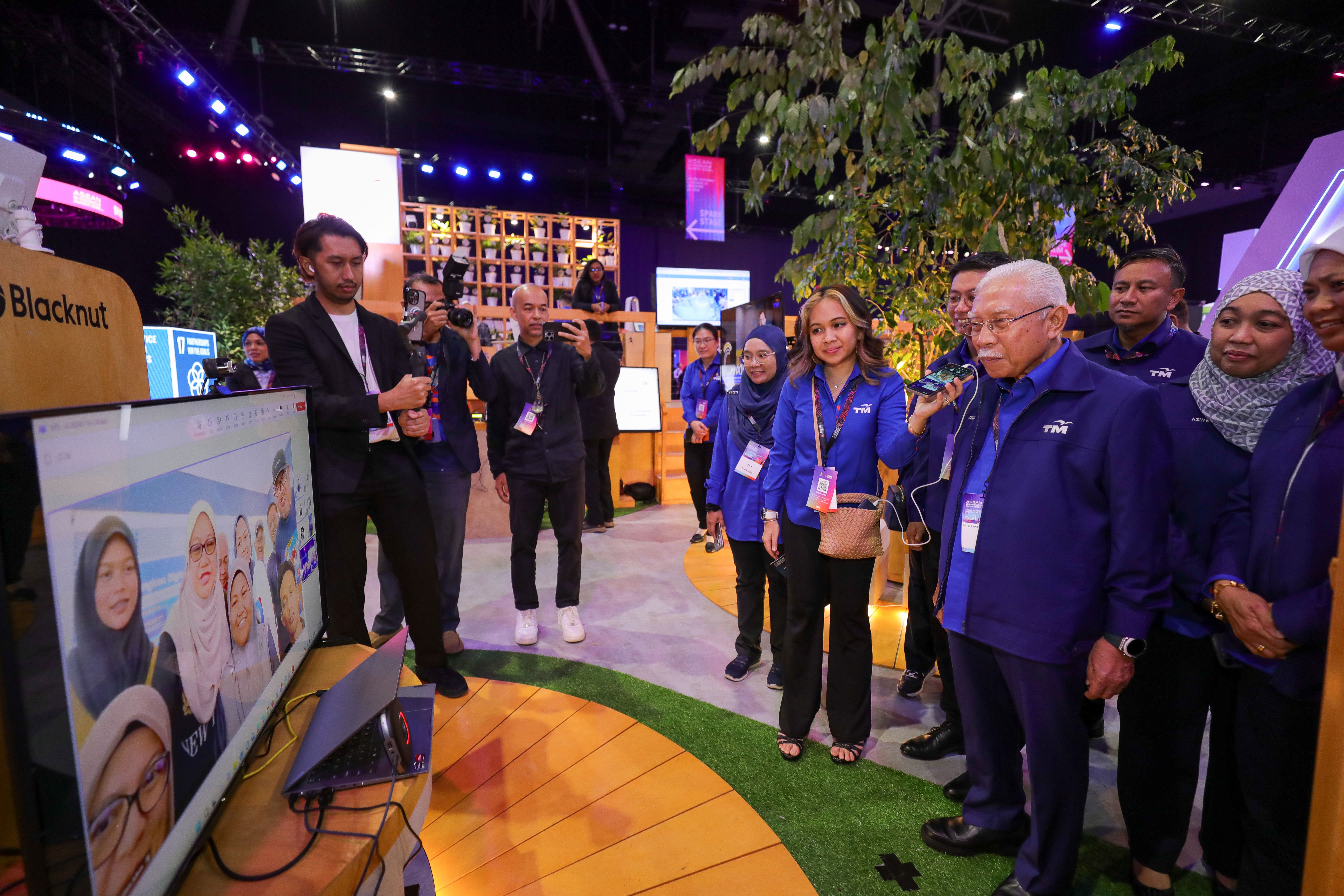
KUALA LUMPUR, 13 AUGUST 2025 – TM underscored its leadership in driving the country’s AI and digital transformation at the ASEAN AI Summit 2025, showcasing intelligent infrastructure and real-world AI solutions powering sovereign AI, smart cities, and the digital economy. Over the two-day summit, TM demonstrated how its sovereign digital backbone, which includes nationwide fibre backhaul, Cloud Alpha Edge (CAE) and GPU-as-a-Service (GPUaaS), is enabling the next generation of secure, high-performance digital solutions. CAE delivers ultra-low latency cloud services hosted entirely in Malaysia, ensuring data residency, regulatory compliance, and operational resilience, while GPUaaS complements this with scalable AI compute power, allowing organisations to develop and deploy AI models without heavy upfront investment. Amar Huzaimi Md Deris, TM’s Group Chief Executive Officer, said, “As the country’s trusted digital partner, TM is building an inclusive, secure, and sovereign digital infrastructure for communities, organisations and the government sector, advancing both Malaysia and ASEAN’s collective digital transformation. “Beyond intelligent networks, sovereign cloud, and AI solutions, we are mobilising an AI-competent workforce and cultivating a collaborative ecosystem, central to our aspiration of becoming a Digital Powerhouse by 2030. These efforts are key to revitalising Malaysia’s innovation ecosystem and positioning it as ASEAN’s leading digital hub,” Amar added. Applauding Efforts to Strengthen Cloud and Digital Ecosystem The Summit also marked the launch of the National Cloud Computing Policy by Minister of Digital, YB Gobind Singh Deo. On this, Amar said, “TM applauds the Ministry’s efforts to strengthen Malaysia’s cloud and digital ecosystem. As the only Malaysian Cloud Service Provider under MyDIGITAL, we’re committed to building a future-ready cloud environment that accelerates Malaysia’s digital journey, enables the public sector to deliver better services, and supports organisations to grow securely and sustainably. “Through our cloud and digital arm, Credence, we offer secure, sovereign, locally hosted cloud and AI services, including Cloud Alpha Edge and GPU-as-a-Service. These services are housed in TM’s certified data centres across key business zones in Malaysia. By combining 5G, cloud, and AI, we’re providing the power and performance needed for next-generation applications, backed by global security and reliability standards,” Amar explained. From Infrastructure to Intelligence TM’s showcase at the Summit, themed the TM AI Park, highlighted how this sovereign digital backbone is already enabling real-time, data-driven services through impactful use cases: · Sustainability – Smart Urban Forestry uses AI, LiDAR and Digital Twin technology to help city councils monitor tree health, biomass and carbon stock—enabling smarter planning and carbon credit readiness. · Healthcare – eHealth Screening delivers contactless, AI-powered health assessments via camera, while PulseWise provides offline respiratory diagnostics for ambulances and rural clinics—bringing fast, accessible healthcare to the front lines. · Digital Lifestyles – LAILA, a lifestyle assistant, offers personalised nutrition, skin and self-care guidance using AI language and vision models. Edge Gaming leverages TM’s low-latency infrastructure for immersive entertainment and AR/VR training. · Productivity – AI Tourism Assistant generates personalised itineraries through a multilingual chatbot, while NeuraNote automates meeting transcription, summaries and sentiment analysis—boosting workplace efficiency. Beyond technology, TM showcased how it integrates inclusive digitalisation and AI into its community upliftment initiatives, such as the transformation of Kampung Mukut in Tioman Island with enhanced education, livelihoods, and essential services. TM’s Future Skills Programme also equips students nationwide with robotics, coding, real-time data logging and other tools that prepare them for digital futures. By driving these initiatives, TM is ensuring that AI and digital innovation deliver tangible benefits—uplifting communities, empowering organisations, and strengthening public services across Malaysia. To learn more about how TM’s intelligent infrastructure and sovereign AI platforms are shaping a smarter, safer, and more connected nation, visit www.tm.com.my.
Akademi Sepaktakraw Malaysia to Boost National Talent Pipeline
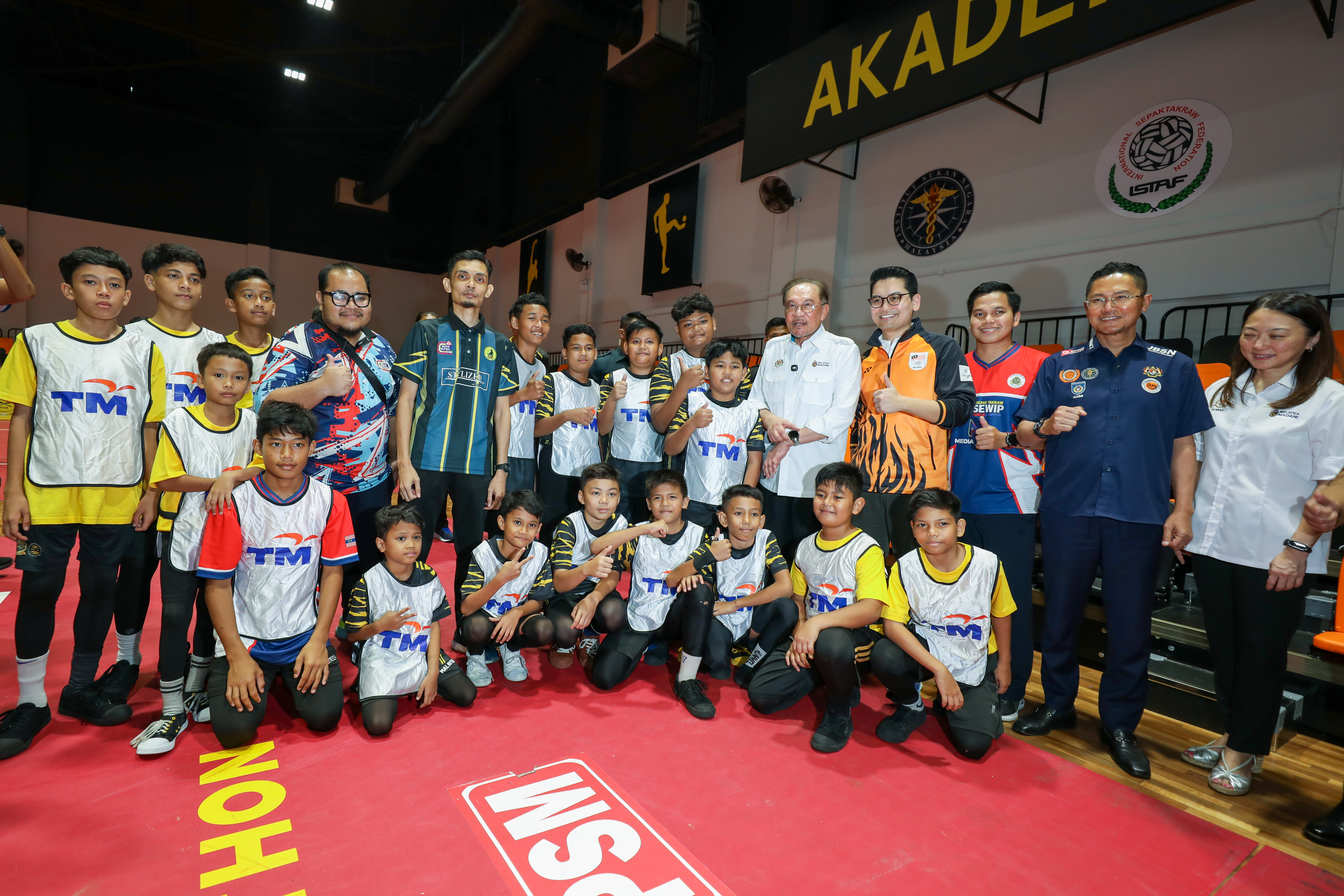
KUALA LUMPUR, 14 April 2026 – Sepak takraw, a sport deeply rooted in Malaysia’s heritage and identity, marked a significant milestone today with the official launch of the inaugural Akademi Sepaktakraw Malaysia, officiated by YAB Dato’ Seri Anwar Ibrahim, Prime Minister of Malaysia.The Akademi signals a renewed national commitment to revitalise and elevate sepak takraw through a more structured, sustainable and future-ready development ecosystem. As the world’s first full-fledged national sepak takraw academy, it serves as a main centre for training, development and high-performance preparation, aimed at nurturing talent from grassroots to elite levels and supporting athletes across multiple pathways. Established under the Persekutuan Sepaktakraw Malaysia (PSM), the Akademi complements existing national sepak takraw initiatives and strengthens a more integrated talent pipeline, reinforcing Malaysia’s competitiveness on the regional and international stage.PSM President, Dato’ Mohd Sumali Reduan said, “Sepak takraw is an integral part of our national identity and continues to bring pride to Malaysia on the international stage. With the Akademi Sepaktakraw Malaysia, we are putting in place a more structured and sustainable pathway for talent development, ensuring athletes are equipped with the right support, facilities and exposure to succeed. We are proud to work alongside partners such as Telekom Malaysia (TM), whose role in strengthening this ecosystem is critical as we continue to elevate the sport. Through this collective effort, we aim not only to produce champions, but to ensure Malaysia remains competitive and respected in the global sepak takraw arena for decades to come.In conjunction with the launch, TM was announced as the Official Technology Partner and Exclusive Connectivity Provider for the Akademi Sepaktakraw Malaysia, delivering high-speed broadband connectivity to support daily operations, athlete needs and live match requirements. Through Unifi TV, TM also provides exclusive hotel TV entertainment, offering uninterrupted access to premium channels at the Akademi’s accommodation facilities. These underscore TM’s broader role as the Official Partner of the National Sepak Takraw Team, reflecting a continued commitment to supporting the sport across its full ecosystem.TM Group Chief Executive Officer, Amar Huzaimi Md Deris, said, “We are proud to support the continued rise of sepak takraw through our role as the Official Partner of the national team, and more recently as the technology partner for the Akademi Sepaktakraw Malaysia in collaboration with PSM. As TM marks 80 years of connecting and empowering Malaysians, we remain committed to supporting sepak takraw and Malaysia’s presence on the global stage. This reflects our commitment to empowering communities and nurturing future talent under our sustainability agenda, in line with our aspiration towards becoming a Digital Powerhouse by 2030.”The collaboration between PSM and TM was formalised in May 2025, supporting the national men’s and women’s sepak takraw teams in major regional and international tournaments, including the ASTAF Asian Cup, SEA Games, Asian Games and ISTAF World Cup. TM also supports sepak takraw talent development through programmes such as the National Sepak Takraw Development Programme (NSTDP) and Kursus Latihan Asas Sukan (KLAS). Through this continued collaboration, PSM and TM share a commitment to strengthening Malaysia’s sporting ecosystem, nurturing national talent and ensuring grassroots sports like sepak takraw continue to empower unity, pride and aspiration for generations to come.
Chairman of Malaysian Communications and Multimedia Commission pays a visit to TM’s 5G use cases in Langkawi
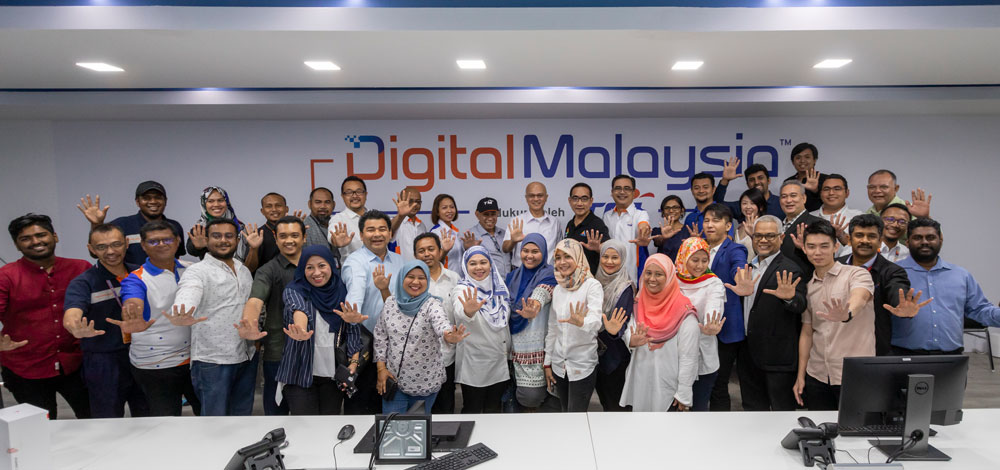
The Company also deployed the region’s first 5G Standalone (SA) network Telekom Malaysia Berhad (TM) was honored to receive an official working visit by Al-Ishsal Ishak, Chairman of Malaysia Communications and Multimedia Commission (MCMC) to TM's 5G use cases in Langkawi, Kedah recently. The transmission of 5G service in Pulau Langkawi is utilising the region's first 5G Standalone (SA) network, deployed by TM. Al-Ishsal and his delegates were received by Rosli Man, Chairman of TM; Ir. Ts. Azizi A. Hadi, Chief Network Officer, TM; Ahmad Taufek Omar, Executive Vice President / Chief Executive Officer, TM ONE; and Dr. Sharlene Thiagarajah, Chief Executive Officer, TM Research and Development Sdn Bhd (TM R&D). Commenting on the visit, Rosli said: "We are very honored to welcome the Chairman of MCMC to experience our 5G use cases which include UNESCO 8K Virtual Reality (VR) at Langkawi International Airport (LIA) as well as to observe TM's 5G network, smart and innovative solution operations centre at its 5G Command Centre (5GCC). 5GCC serves as an integrated command centre for all our 5G network, smart and innovative solutions in Langkawi. As the national telecommunications infrastructure provider of Malaysia's Digital Nation aspirations, we are indeed excited to be part of this 5G Demonstration Project undertaken by MCMC and showcase our 5G use cases. This signifies our support and capabilities to realise MCMC's aspiration in progressing humanity towards improving the quality of lives of the Rakyat. TM, via our innovative and comprehensive products and solutions will continue to work closely with the Government and MCMC to lay the foundation for Industrial Revolution 4.0 (IR4.0) and rolling out 5G nationwide to serve a more digital society and lifestyle, digital businesses and industry verticals, as well as digital Government." During the visit, Al-Ishsal was briefed on TM's capabilities and readiness to deploy 5G network solutions as well as how the Company can power the Government's Digital Malaysia aspirations through its innovative products and solutions. TM also aspires to work together with the local authorities, particularly in Langkawi to make it a safe tourist destination via TM's solutions. Under the 5G Demonstration Project, TM through its enterprise and public sector business solutions arm, TM ONE and its research and development arm, TM R&D are deploying 11 use cases in Langkawi as below: Smart Safety and Security Solutions – a real-time monitoring system consisting of cameras and related monitoring equipment placed in strategic areas to serve variety of purposes, including building/grounds security, crime prevention, and traffic observation and integrated with TM's emergency response team. Smart Agriculture Solutions – a solution that offers single display and real time monitoring that provides information on indoor farming environment's key parameters such as temperature, humidity, grow lights intensity and selected plant parameters that are critical for timely decision making and ensuring optimality of the growth conditions. Smart Traffic Lights Solutions – data driven solution that provides a single dashboard for monitoring and helps to improve traffic flow by reducing waiting time at traffic lights, improve traffic congestions and management of traffic. Smart Parking Solutions – parking system that provides real time parking bay monitoring using camera and Artificial Intelligence (AI) which enable users to search for vacant parking bay via mobile app. UNESCO 8K VR – 8K resolution streaming over cloud, showcasing 2 episodes focusing on (1) geopark & geosites; and (2) lifestyle in Langkawi. Tourists can have a taste of all these hidden treasures through an immersive virtual reality experience for some hard to access locations that are not for the less fit. Smart Tourism "My Smart City" application – a single, integrated mobile app for tourists' convenience as it consists of several features and services such as Trip Planner, Places of Interest, Events & Happenings, Parking, and Alert Button. Smart Retail Analytics – a platform that analyses customer's experience within a physical premise and offers insights to enhance that experience. With this solution, retailers can improve customer experience, sales and brand loyalty as the platform supports customised services, targeted advertising and visitor visibility. Smart Water Management System – an internet of water solution that offers seamless end-to-end smart water integration that improves non-revenue water management, optimises repair and replacement of ageing infra as well as improves response to weather events such as flooding and pollution through smart water level and water quality measurements respectively. Smart Vehicle Management System – a fleet management solution that provides management of commercial motor vehicles for work purposes. Smart Safety Helmet – a data-driven smart industrial helmet that helps make worksite safer by providing live, wireless monitoring and array of sensors (i.e. accident impact and geolocation) to perform various analysis of data. Geolocation People Safety – the tracking solution is designed to protect and connect with people who matters the most that allows users to locate loved ones and receive alert based on safety zone and SOS button through mobile application. With all these uses cases in place and most of it are already up and running, TM has the highest number of 5G use cases among the telcos participating in the 5G Demonstration Project. The demonstration project is for TM to test the new 5G features, explore the 5G technology system and assess the best way to deploy 5G infrastructure nationwide. The transmission of 5G service in Pulau Langkawi has been going live since early December, where TM has deployed the first 5G Standalone (SA) network in the country and the region. The Company is currently testing the implementation of a converged 5G core network which allows co-existence of Non-Stand Alone (NSA) and SA network. SA is the future of the 5G network deployment and this demonstration is crucial to fast track 5G implementation in the country. 5G speed tests conducted within TM's 5G use cases sites have successfully achieved up to 1.5Gbps. TM's aspiration is to deliver efficient and cost effective 5G infrastructure via infrastructure sharing approach, through the access regulations implemented by MCMC. This is by leveraging on its extensive fibre networks, including the submarine cables, telecommunications towers, and Cloud computing as well as ready Data Centres to support the 5G era in Malaysia. In terms of devices and use cases, its wholly-owned subsidiary, TM R&D is also developing and experimenting 5G related equipment to get ready for the upcoming 5G.

NEWSLETTER
Just drop your details and stay updated with the world of Telekom Malaysia. We promise – no spam!